
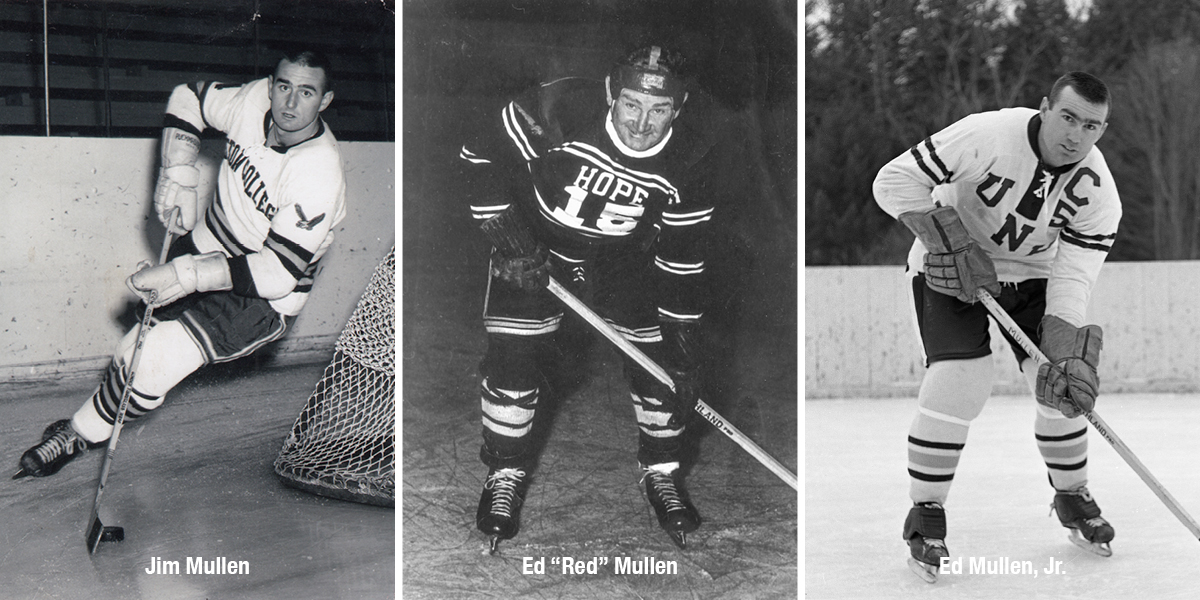
There were no elite travel teams during the winter or power-skating camps in the summer when brothers Jim and Ed Mullen Jr. came of age as hockey players in Rhode Island in the 1950s.
But the Mullen boys had their father, Edward Francis “Red” Mullen Sr., and that’s all they needed.
Ed Jr. and Jim learned to play hockey – and became well-rounded athletes — the old-fashioned way.
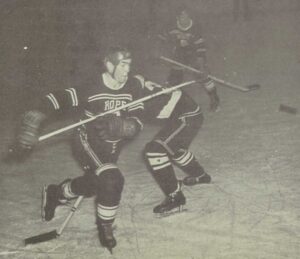
When it wasn’t hockey season, they played football and baseball and lacrosse.
The family’s list of athletic accomplishments is impressive.
Coach Mullen never played the game. However, he was an astute student of the game having guided Hope High School to three RI state championships in 1956, 1960 and 1961 with each of his sons. Hope also posted impressive runners-up seasons in 1953 and 1959.
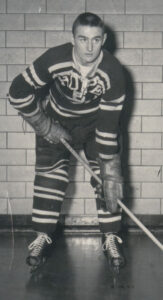
In the early 1950’s, Coach Mullen was surrounded by RI high school legends. Burrillville coach, Tom Eccleston; LaSalle coach, Lou Cimini; and Cranston coach, Howie Crins, became his mentors.
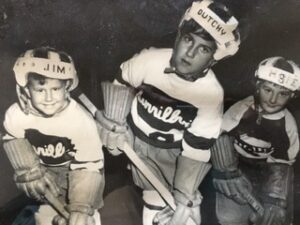
Their young boys would also entertain the schoolboy hockey crowds between periods of their games at the old RI Auditorium, when that tradition was held in the 50s..It was there that Jim Mullen at Don Eccleston became great friends, competing against each other as stars at Hope and Burrillville in high school and then at Boston College and Brown when both reached the final four at Meehan Auditorium in 1965.
Coach Mullen also developed a strong bond with a number of New England prep school and college coaches, which opened doors for his players to educational/scholarship opportunities.
Ed Jr. captained his hockey team at the University of New Hampshire, where he also starred in football before graduating in 1962. He passed away at 85 in 2025.
Jim was a star and Hall of Famer at Boston College. He graduated in 1966.
In addition to their accomplishments in sports, the Mullen brothers fought bravely for their country in Vietnam.
Their father grew up in Lowell, MA. He worked at the Sockanosset School for Boys, the juvenile detention facility and reformatory in Cranston, before getting a job teaching physical education and coaching at Hope High School on Providence’s East Side.
Home base for the Mullen clan was the Governor Francis Farms neighborhood in Warwick. Jacqueline O’Connor, Jim and Ed Jr.’s sister, is 90 years old and still lives in the family home.
Their mother, Mildred, taught in the Warwick school system for over 20 years while providing unconditional support for the academic and athletic endeavors of her three children.
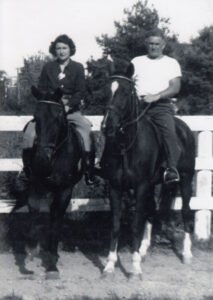
During the high school hockey season, Jim recalled getting up at 5:30 a.m. and driving to school in Providence with his dad.
“He would freeze the tennis courts at Hope High School. Sometimes we’d have early ice at the Auditorium and then go to school,” said Jim.
After starring for Hope’s 1960 state championship team, All-Stater Jim was informed by his father that his next stop would be Kimball Union Academy in New Hampshire, where he would repeat his junior year.
His brother Ed had taken a similar path to KUA based on their dad’s very friendly relationship with George Akerstrom, who had built a strong athletic program at KUA
Interestingly, the Boston Bruins briefly entered the picture around that time.
In that era, before the NHL Draft came into existence, the six NHL teams held territorial rights to players in their geographic area.
In the Fall of 1960, the Boston Bruins invited 16-year-old Mullen to their training camp and became interested enough to invite father and son to a game at the Boston Garden.
“We went up, watched a game in the press box,” said Jim.
But heading off to play junior hockey in Canada was the development path NHL teams lived by for teenage prospects in that day and age. That would have compromised Mullen’s NCAA eligibility.
“My father said, ‘Jim, you’re not going because you would not be able to play in college. You’d be a pro,’” Jim said.
“Back then, there were six teams in the NHL and only one American (Minnesotan Tommy Williams of the Bruins). ‘You’ve got no shot. Go to prep school, get your grades up,’” was the message from Ed Sr., Jim recalled.
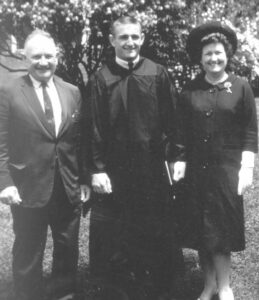
While that was going on, Ed Jr. was making his mark as a scholarship athlete at UNH, playing football, hockey and lacrosse.
“Eddie was a defenseman and captain of his UNH team,” said Jim.
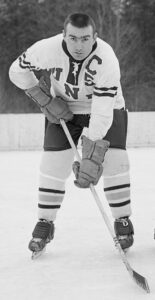
As Jim finished up at KUA, he had offers to play football at Maryland and West Point, but hockey was his first love.
He decided on Boston College, coached at the time by John “Snooks” Kelley. “It was the place to go as far as hockey, back then,” said Jim.
“Snooks Kelley was a legend. I lost my dad freshman year. Snooks sat me down and said, ‘OK, I’m your father now.’ That was a great thing for me.”
At first, there was some culture shock at the rink, to be sure.
“I was the only out-of-stater. They called me a foreigner. Think about adjusting to a team where you don’t know anyone. Didn’t grow up with them, didn’t play hockey with them. It was all new. They didn’t want to talk to you. Thank God I was (a good player),” Jim said.
One benefit of going to BC was that Mullen received a new pair of skates.
“(Rhode Island Reds trainer) George Army befriended my dad. I didn’t have my own skates until I went to Boston College. I had old Rhode Island Reds skates,” he said.
He hit his stride as a junior at BC in 1964-65, playing on a line with Phil Dyer and All-American John Cunniff.
Compiling a total of 168 points that year, they were the highest-scoring line in NCAA hockey as the Eagles went 24-7 and won the Beanpot and the ECAC Championship, earning an invitation to the NCAA Tournament.
That trip to the national championship wasn’t quite what Mullen had dreamed of.
“As a kid, I wanted to go to the national championship someday. I wanted to go out west, to play at North Dakota or Michigan,” Jim said.
“Where do you think it was in 1965? We took a bus from Boston to Providence to play at Meehan Auditorium. How exciting was that?” he said sarcastically, still disappointed decades later.
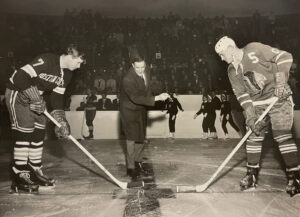
Hopes were high for the following season as Mullen, Cunniff and Dyer returned as seniors, but injuries struck.
“John Cunniff got hurt six weeks into the season, (Dyer) got hurt as well. I ended up playing with Jerry York. So that senior year was a mishmash and we never got back to the Final Four,” Mullen said.
Mullen finished his BC career with 106 points (60 goals, 46 assists) in three varsity seasons. (Freshmen were not eligible in those years.)
He played on Beanpot championship teams in 1964 and 1965 and was named to the Beanpot All-Tournament First Team in 1965.
Mullen was inducted into the Boston College Varsity Club Athletic Hall of Fame in 2000.Today he remains in the Top Ten in points per game for the Eagles.
As impressive as the athletic careers of the Mullen brothers were, what they did immediately after college overshadows anything they did on the ice or football or lacrosse field.
“College hockey was a piece of cake,” compared to what came next, Jim said.
Ed Jr. joined the U.S. Army, went to aviation school and soon was deployed to Vietnam to fly helicopters.
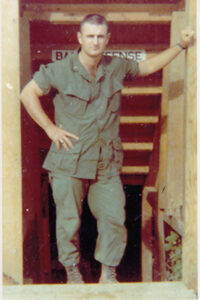
“My poor mother was sitting at home watching the Vietnam war on TV, she had two sons in it. We were in the battle. I was on the ground, 13 months in the bush. Makes me appreciate life,” said Jim.
“Today I pay the price – PTSD, pulmonary fibrosis, breathing issues, Agent Orange. I’ve got some real issues today, which I’m dealing with the (Veterans Administration).”
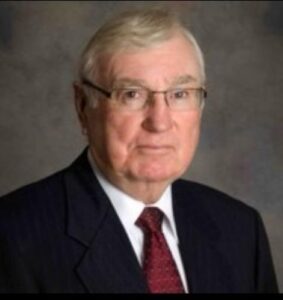
Jim left his military service as a captain and recipient of the Marines’ Bronze Star Medal with Combat “V” designation, recognizing acts of heroism, valor, or direct exposure to personal hazard during combat operations. He transitioned into a long and successful career in the business world.
“My first job was with the Xerox Corp. in Boston. I spent 25 years in that world, office products,” he said.
Before retiring, he was vice president of sales for 15 years at Dexter-Russell of Southbridge, Mass., a cutlery manufacturer.
He continues to keep a close eye on Boston College, where he has season tickets.
“The talent nowadays is amazing. Back when I played you didn’t have four lines. You might have had three lines and the third line didn’t play,” he said.
By Mark Divver