If you want to understand how hockey took root in Rhode Island, look beyond the Providence Reds.
The Reds were the big show: pro hockey, packed nights at the Rhode Island Auditorium, and championships. But alongside them — and sometimes remarkably close to them — was another team, the Rhode Island Scarlets.
The Scarlets were an amateur team that drew from some of the best local players in the state and competed against strong teams throughout New England. And they shared the Arena, equipment, and an intriguing cast of characters with the Reds.
Origins
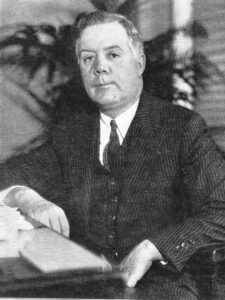
The story starts with Hubert C. Milot, the Providence businessman and hockey fan who spearheaded the effort to build the Rhode Island Auditorium.
Milot was educated at LaSalle Academy in Providence and, later, St. Mary’s College in Montreal. At St. Mary’s, he befriended classmate Leo Dandurand, who would later come to own, manage and coach the Montreal Canadiens. As the NHL sought to expand in 1924, Hubert visited Montreal to investigate establishing an NHL franchise in Providence. He returned to Providence and set about gathering support to build a premiere sports arena. The Rhode Island Auditorium opened in February 1926.
With Milot serving as the Auditorium’s general manager, ice skating exhibitions and amateur, high school and collegiate hockey were regular attractions.
The Reds played their inaugural game on Dec. 3, 1926, with players supplied by Leo Dandurand, Milot’s longtime friend, and the Montreal Canadiens.
After losses in their first three games, Reds head coach Jimmy Gardner and general manager Jean Dubuc began looking for more talent. One of the athletes who drew their attention was Curley Oden, a local sports legend. Oden had captained the ice hockey team at Providence’s Classical High School and played football and baseball at Brown University. By 1926, he was a star running back and receiver for Dooley’s NFL team, which won the lea.
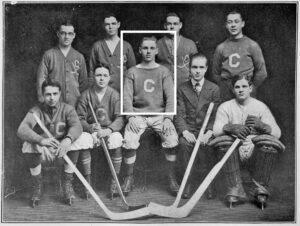
The next year, Milot took control of that club and renamed it the Rhode Island Scarlets for better association with the Reds. They played against teams from Massachusetts, Connecticut and New York.
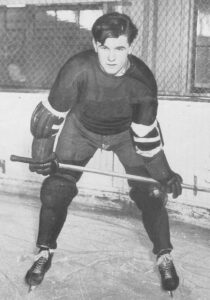
The Scarlets, with Milot as coach, went on to win the 1932 New England Amateur Athletic Union championship in a tournament played at the Auditorium. Later that season, the Scarlets became the first Rhode Island team to compete for the Senior National Championship. Stars included Jimmy “Ace” Hart and George “Pud” Quirk of Hope High School, Howie Crins of Technical High and Clem Harnedy of LaSalle.
The Reds’ Influence
Goalie Paddy Byrne joined the Reds for the 1932-33 season, and he also took over management of the Scarlets. This coincided with the birth of the Rhode Island Inter-City Amateur Hockey League. The Scarlets roster was meticulously handpicked from the top-performing players across the entire Inter-City league to represent Rhode Island in regional and national tournaments.
Byrne was the first of many Reds players and associates who would manage the team.
Fred “Bun” Cook was already a hockey legend when he arrived in Providence. As a player, he had been part of the New York Rangers’ famous Bread Line. He retired after the 1936-37 season, and he came to Providence to as player/coach with the Reds – and coach of the Scarlets.
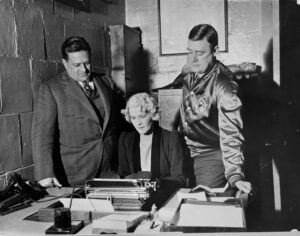
While Cook was building teams on the ice, Louis A. R. Pieri was becoming the man who could make the entire operation work. Pieri joined the Rhode Island Auditorium as general manager in 1929. A decade later, after the Depression put the Auditorium into dire financial straits, Pieri emerged as owner of both the Arena and the Reds.
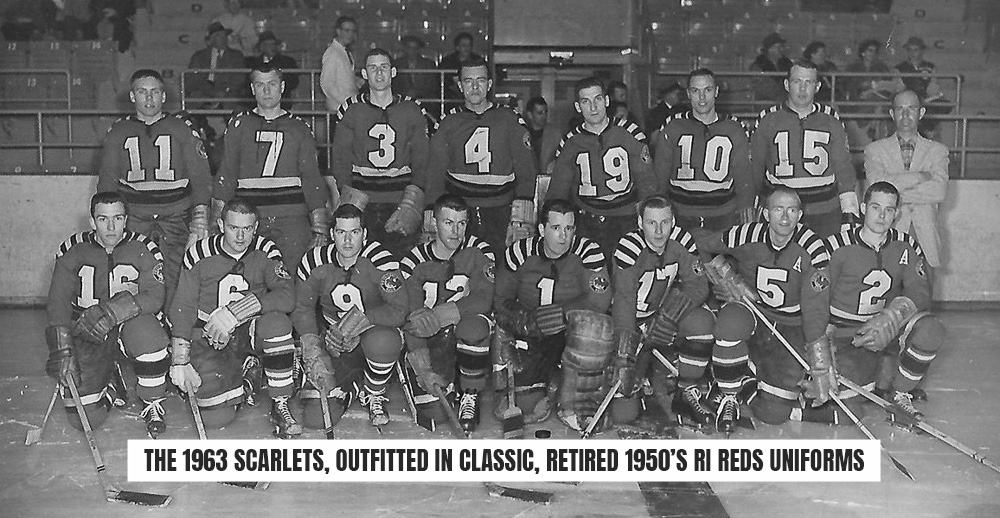
Under Pieri’s leadership, the Reds became one of the great minor-league franchises in hockey history, winning four Calder Cups. And the Scarlets continued to benefit from his interest and sponsorship. The Scarlets continued to play at the Auditorium, often in donated Reds uniforms. Pieri steered more experts to lead the team.
Ahead of the 1939-40 season, Jim O’Rourke took over as coach, and the season proved to be a masterful showcase of Rhode Island talent. The Scarlets finished the regular season in a tie for first place and vanquished the Boston Junior Olympics to claim the league championship.
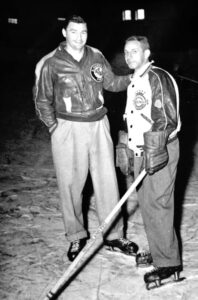
In 1947, the Scarlets joined the Atlantic Amateur Hockey League. Their coach was Johnny “Black Cat” Gagnon, who played for the Reds in the late 1920s before moving to the Montreal Canadiens, where he won the Stanley Cup in 1931. He later played for the Boston Bruins and New York Americans before returning to Providence to finish his playing career in 1945. Gagnon’s roster for the Scarlets included, among others,
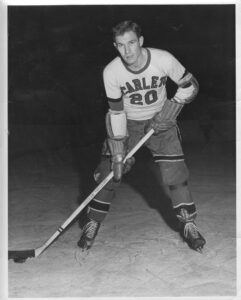
Kilmartin, Thayer, and Warburton would join the U.S. National Team. Bentley would eventually play goal for the Reds. Mellor would become a pioneer of youth hockey in Cranston, R.I. and Dooley, son of the Reds’ founder, would go on to coach the Scarlets in 1948-1949 and enjoyed great success. With an arsenal of talent, headed by Kilmartin, Thayer, Warburton and Bentley added to their numbers, they captured the
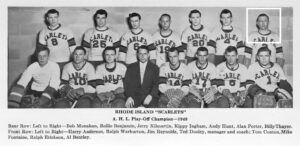

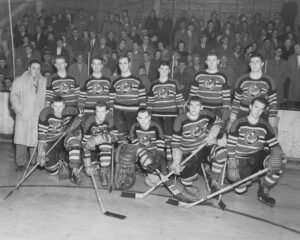
The Scarlets continued to compete into the 1960s, notably winning the 1961–62 Massachusetts Senior Class A Fall Hockey Championship. They put together a stellar run, winning nine games and tying one, including a decisive 6–3 victory over Burrillville’s Fairbanks Electric in the final game.
But the landscape for amateur hockey was changing. The NHL amateur draft began in 1963 and slowly dissolved the sponsorship system that had nurtured the Scarlets and other senior amateur teams.
The Scarlets played their final game on Jan. 12, 1966, ending in a 3-3 tie with St. George’s School of Middletown, R.I.
By Mike Bailey